
Imagine an AI that finds a bug in an image decoder, fixes it, and supplies a mathematical proof that the repaired program cannot crash.
Now imagine that its fix is to reject every image.
The proof might be perfectly correct. The decoder might also be perfectly useless.
That does not make crash freedom a bad property to prove. It means crash freedom and correct decoding are different requirements, and we can establish one without a complete specification of the other.
This small example captures both why I am excited about Anthropic’s recent work with Theorem on AI-assisted formal verification, and why I think it opens a much larger research program. We are beginning to automate meaningful guarantees about real software. We can start with targeted safety guarantees, then build toward richer accounts of functionality, the environment, and the changes we make to running systems. Throughout, a separate question remains: have we specified the right requirements?
What Anthropic actually did
Anthropic reports proofs for 239 fuzzing entry points across 123 open-source libraries. Claude constructed Rocq-checked proofs about compiled RISC-V programs, for inputs under 64 MiB and under other stated bounds, and found and patched bugs along the way. These are reported results; I have not independently replayed the proofs.[1]
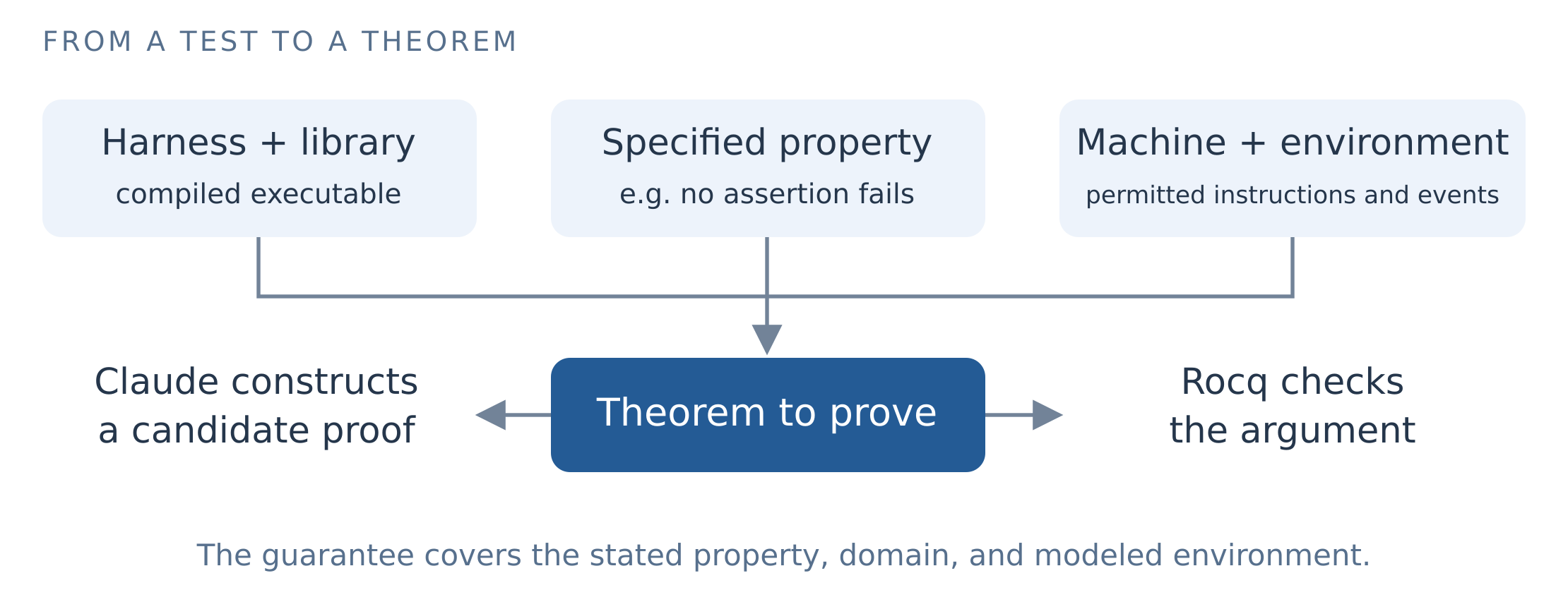
The central idea is to start from existing fuzzing infrastructure. A fuzzing harness is a small program that feeds inputs into a library and checks for failures. Developers have already written thousands of them for Google’s OSS-Fuzz. The project uses them to mechanically generate mathematical claims about the resulting executables.[1]
A fuzzer might throw millions of damaged images at our decoder. Every failure it finds is useful; every successful run is evidence about one more execution. A proof asks a different question: is the specified failure possible for any input in the covered domain? Showing that a loop index stays within its buffer on every iteration, for example, covers an enormous number of executions without running any of them.
A test shows that a particular execution worked. A proof can establish why an entire family of executions must satisfy a property.
Claude’s job is to construct that argument. The proof checker’s job is to verify each step. A plausible-looking argument that fails the checker does not count.
The guarantee covers the stated property, domain, and modeled environment. The theorem and execution semantics, not the model that proposed the proof, determine what has been established.
AI is changing where proof automation happens
Automated reasoning predates LLMs by decades. Provers such as Vampire search for proofs from logical premises; SMT solvers such as Microsoft’s Z3 decide constraints over arithmetic, arrays, and other structures used in software.[7] Interactive provers such as Lean and Rocq work differently: a human chooses the induction, supplies the invariant, introduces the lemma, and the prover checks the result.[6]
LLMs are changing that division of labor. An agent can inspect a proof obligation, propose a lemma, try tactics, read the prover’s feedback, and revise. Wrap that loop around an interactive prover and the combined system constructs proofs automatically. DeepSeek-Prover-V2 does this in Lean; Anthropic’s workflow does it with Claude and Rocq.[8]
Solvers remain valuable inside this loop. Anthropic’s appendix includes a Python interpreter in Rust whose proofs went through Verus, which relies on Z3.[2] What changes is how much of the surrounding argument (invariants, lemma structure, library search) can be assembled automatically. AI expands the search for proofs; the prover keeps the standard for accepting them.
A safety specification is a useful starting point
A specification states a requirement precisely enough to check. “No out-of-bounds memory access occurs” is one. “Every valid image decodes to the pixels this format defines” is another, describing functionality the first leaves open. A complete account of a decoder’s intended behavior is hard to write. Proving a targeted safety property delivers value long before we have one.
This is why reusing harnesses is promising. Developers have already chosen the checks they care about, and an assertion turns a desired relationship into a detectable failure. If that check survives compilation into the binary, proving the failure unreachable establishes the relationship across the covered domain.[1][5] An assertion compiled out of the build proves nothing.
The safety property has a precise scope too. Here “crash” means a fault, an abort, or an error the sanitizer detects. AddressSanitizer catches many memory errors, but not all.[1][5] The guarantee is freedom from the errors the instrumentation can see, which is narrower than full memory safety. It is still meaningful: a decoder that works on ordinary files but corrupts memory on a malicious one needs exactly this kind of improvement.
The practical progression is to prove a useful property, then strengthen the specification. We do not need to solve the whole specification problem first.
The environment is part of the theorem
Our decoder asks the operating system for memory and reads files. Those calls can fail or return unexpected results, so the proof must say what they are allowed to do.
The released Linux process model represents operating-system responses as sets of permitted outcomes. A read can return any nonempty prefix of the available data. An unhinted allocation can return any free, page-aligned region. The stack address, initial program break, and memory-mapping base at program start are left open, while the binary itself loads at fixed addresses. A proof must cover every choice the statement admits.[3]
For a safety proof, it is safe to allow extra behaviors in the model: if none of them leads to an error, the real program should be safe too, as long as the model includes all of its possible behaviors. But all of the released proofs make a different claim: that two builds have exactly the same observable behaviors. Here, extra behaviors can be misleading. Two builds might appear to behave identically in the model even though they differ on Linux. Theorem’s documentation acknowledges this limitation.
The model has one thread, no signal handlers, an 8 MiB stack, and a filesystem without a full directory tree, symbolic links, or permissions. Operations it does not interpret count as errors that proofs must exclude.[3] In most released statements, memory requests fail only when the budget is exhausted or no address range is free, and the budget is a premise: 2 GiB for the uninstrumented build in AddressSanitizer statements, 16 GiB in UndefinedBehaviorSanitizer statements. Inputs needing more are simply not covered.[4]
The proofs establish meaningful guarantees within the modeled setting. Applying them more broadly requires accounting for how the code is used in practice. For example, a decoder inside a browser may face concurrent calls and resource constraints that an isolated test harness does not model. Covering every input to the harness does not capture these interactions.
The executable matters
The proofs apply to compiled binaries, the programs that actually run. This avoids having to assume that compilation preserves the properties proved about the source code. The guarantees still depend on the accuracy of the instruction and operating-system models, as well as the tools used to load the executable into the model.[5]
The work also connects the binaries used in verification to the ones people typically run. The researchers prove that, for the specified inputs, binaries with and without sanitizer checks agree on observable behavior, including their output, their exit status, and the final state of the filesystem.[2] This raises a natural question: can we use similar techniques to check whether a patch preserves a program’s intended behavior?
What would it mean to prove a fix?
Suppose our decoder trusts a length field in an image header, and an attacker uses it to write past a buffer. The AI adds a check. The malicious image is rejected, and we prove the memory error unreachable for covered inputs.
We also want valid images to keep working, their pixels decoded correctly, and perhaps existing error codes preserved. A useful repair needs two connected arguments: it eliminates the prohibited behavior, and it preserves the behavior we still require.
A deliberately simple example, not a patch reported by Anthropic. Crash freedom alone does not distinguish “reject everything” from the useful repair.
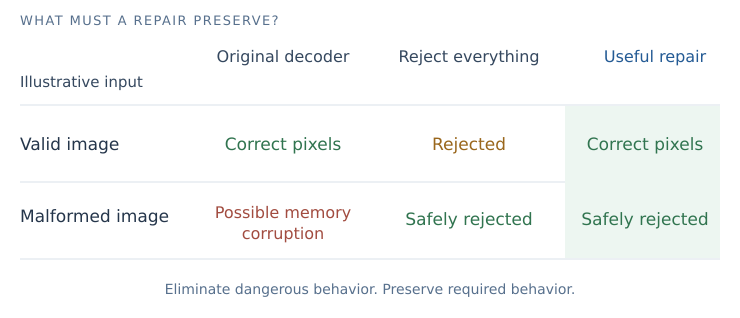
We cannot demand identical behavior everywhere; a patch exists to change something. We need to say where behavior may change, what replaces it, and what stays fixed. Sometimes a format specification answers that. Often the hard part is deciding which old behaviors were promises and which were accidents. Size does not settle it: a one-line patch can disable a critical feature, and a change affecting few inputs can break every file from an important customer. How many inputs change is a mathematical question. Whether they matter is a question about the system’s purpose.
Anthropic explicitly recognizes the degenerate-repair problem. Its workflow penalized every patch, offered extra credit for proving which inputs a patch changes and how few they are, and logged and audited the patches.[1] That incentive measures the size of a change, not whether the change preserves required functionality; a guarantee of the latter would be an additional result. Note, too, that equivalence between a checked and unchecked build is a different relation from equivalence between an original program and its repair.
But who checks the specification?
AI may make much richer specifications affordable, extracting requirements from documentation, tests, callers, and developer discussion. That would remove a major obstacle. It leaves a deeper question: do those contracts express what we actually want?
Suppose an AI specifies that our decoder must produce correct pixels whenever it accepts an image, then proves a patch satisfies this. A decoder that rejects everything still qualifies; the requirement never says which images must be accepted. We can require acceptance of every supported valid image, but someone must still define “supported” and “valid.” A rare format feature a customer depends on may be missing from the contract, and no proof checker will notice.
A checked proof establishes that the program satisfies the stated requirement. Whether that requirement captures our intent is a separate obligation.
This applies even to targeted safety claims: which failures count, which inputs are covered, which conditions are assumed. There are concrete ways to gain confidence. Review contracts against documentation and real uses. Test whether deliberately bad implementations are excluded. Use counterexamples to expose missing cases. Prove that detailed contracts implement higher-level ones, which moves the question upward without eliminating it. AI can help with each step. The real opportunity is a feedback loop in which requirements become explicit and inspectable, and people can correct them before they become the standard the software is proved against.
From individual guarantees to systems that keep their guarantees
The future I find exciting is software accompanied by evidence about its behavior, maintained as the software changes. For our decoder, that means progressively stronger claims: it avoids specified memory errors, it finishes on supported inputs, it computes the correct result, its repairs preserve what callers rely on.
Those require different arguments. In particular, crash freedom does not establish termination, and a decoder that silently loops can still be a denial-of-service problem.
Here the public record is inconsistent, and I cannot resolve it from what has been released. Anthropic’s announcement says Claude proved these programs always exit normally.[1] The appendix’s statement of the theorem has no halting clause and notes that a silently looping program simply produces a trace that ends, so the equivalence argument cannot distinguish looping from finishing.[2] The public release states that its agreement statements do not exclude non-terminating runs and that none of its proofs establishes a halting statement.[5] Whether the unreleased proofs establish termination, I cannot determine. Until that is clarified, I read the guarantee as excluding errors on executions that occur, without ruling out executions that never end. The repository does define halting statements, and proofs of them are being contributed, which is exactly the strengthening this progression calls for.
Composition is the next challenge. A library may require callers to keep a buffer alive until an operation completes; callers may rely on the library leaving other memory alone. Explicit contracts let each component’s proof support the next.
Doing this repeatedly will require reusable abstractions. The appendix’s expert discussion finds the generated proofs verbose, repeatedly spelling out low-level execution details that human proof engineers would factor into general principles, and leaves open whether that style scales.[2] I see an opportunity: AI can help discover the invariants and abstractions that make the next proof cheaper and more general.
A reason to be ambitious
There is a tempting response to every verification result: list the assumptions and declare that reality is more complicated. Reality is more complicated. The productive question is which part we can capture next, and what stronger guarantee that would support.
Anthropic’s work demonstrates a route from existing code and tests to machine-checked evidence at substantial scale. Proof checking separates a model’s ability to find an argument from the machinery that decides whether it is valid. Environmental models record which interactions were considered. Behavioral specifications record what must survive a repair, and examining them is how we ask whether the guarantees match the system’s purpose.
The goal should be a development process in which every proposed change comes with explicit answers: what danger did this remove, what functionality did it preserve, and under what conditions do those claims hold? Alongside the proof, we should be able to inspect the requirements, and the reasons for believing they are the right ones.
We are still near the beginning. That is a reason to build.
Author’s note: I use AI tools for editing and research assistance; the arguments and views here are my own.
Sources
[1] Anthropic, LLMs are making formal software verification feasible at a much larger scale, October 22, 2026. Reported results, the harness-to-proof workflow, assertions, patch safeguards, and the announcement’s description of the proved property.
[2] Anthropic, technical appendix (PDF). The theorem statement, binary equivalence and observations, the treatment of non-terminating runs, the Verus/Z3 interpreter case study, and the expert assessment of proof structure.
[3] Theorem, Linux process semantics documentation; model source at rocq-linux-process-semantics. Environmental choices, entry-state quantification, modeling boundaries, and the precision caveat for comparison statements.
[4] Theorem, theorem-statement documentation. Memory budgets as premises and allocation-failure settings.
[5] Theorem, public proof repository (checked October 27, 2026). Released guarantees, the trusted base, conditions under which harness assertions carry over, and termination limits. The public subset contains proofs for entry points that did not require patching, and should be distinguished from the full results reported in the announcement. See also the pending halting-statement contribution.
[6] Rocq, Reference Manual: proof mode. Interactive proof construction, tactics, proof states, and kernel checking.
[7] Vampire, project repository; Microsoft Research, Z3. Established automated reasoning tools and their applications in software verification.
[8] Ren et al., DeepSeek-Prover-V2: Advancing Formal Mathematical Reasoning via Reinforcement Learning for Subgoal Decomposition (2025). LLM-based formal theorem proving in Lean 4. For Claude and Rocq, see [1].