
There are two broad approaches to AI safety. One focuses on the model: improve its training, shape its preferences, and make it choose better actions. The other focuses on the system around it: permissions, sandboxing, information-flow controls, and checks that do not depend on the model choosing correctly.
They should coexist. Better models make fewer dangerous choices; external controls constrain what happens when they do. I have written about the external system side in The AI Didn’t Disobey. It Generalized. Your Sandbox Failed, and elsewhere in this blog, because I believe it receives less attention than it deserves. Here I want to examine model-centered alignment on its own terms: why should matching human judgments today lead to compatible judgments tomorrow?
The question is not whether AI can recognize human values. It clearly can. The question is whether learning our answers also teaches it how we generalize. One compelling optimistic answer invokes what I will call the Platonic Manifold Ideal: perhaps capable intelligences discover sufficiently similar underlying structures that their judgments converge even in unfamiliar cases. I think that ideal is unlikely to hold strongly enough for reliable moral alignment, although I could be wrong.
Intelligence Needs a Shortcut
The space of possible sentences, experiences, and decisions is astronomically large. Yet a human brain, with finite memory and energy, handles novel sentences and unfamiliar situations every day.
Presumably, cognition exploits a compact generative structure rather than consulting an impossible lookup table. Unless the human mind does something magical beyond ordinary computation, there should be an efficient computational account of much of what it does.
This makes the manifold hypothesis appealing: observations in an enormous space may be organized around a much smaller structure capturing their meaningful variation. I think this is likely true in a useful sense. A literal smooth manifold is not required—compact structure could also be discrete, hierarchical, or compositional—but geometry is a helpful picture.
Human moral judgment likely exploits such structure. We do not memorize the answer to every moral dilemma; we extend ideas of harm, trust, fairness, and obligation to unfamiliar cases.
AI models learn compact representations too. But the existence of structure does not imply its uniqueness. Efficient computation does not tell us which structure a learner will discover, much less whether two learners will discover compatible ones.
A Million Matching Answers
Imagine two systems that agree on a million moral questions. Both recognize deception, cruelty, and the difference between accidents and deliberate harm.
Are they aligned?
Not necessarily. Any finite set of answers is consistent with many decision rules. Those rules may agree on everything tested and disagree on the next case.
We do not need perfect agreement. Humans disagree with one another. A more sensible goal is a very high probability of agreement on consequential situations, with serious disagreements especially rare.
But that makes the question sharper: what gives us reason to expect high agreement on situations neither system has encountered?
Seven Zeros, Two Different Futures
Suppose we observe a function at seven consecutive positions:
0, 0, 0, 0, 0, 0, 0.
What is the rule?
If we prefer the lowest-degree polynomial fitting the observations, the answer is easy: a flat line at zero. It stays zero everywhere.
But if we allow oscillatory functions, a wave can pass through those very same seven points while rising and falling between them. For example, the simple wave sin(πx) is zero at every integer, but not between integers.
Both explanations fit the data perfectly. One stays flat; the other oscillates where we have not measured.
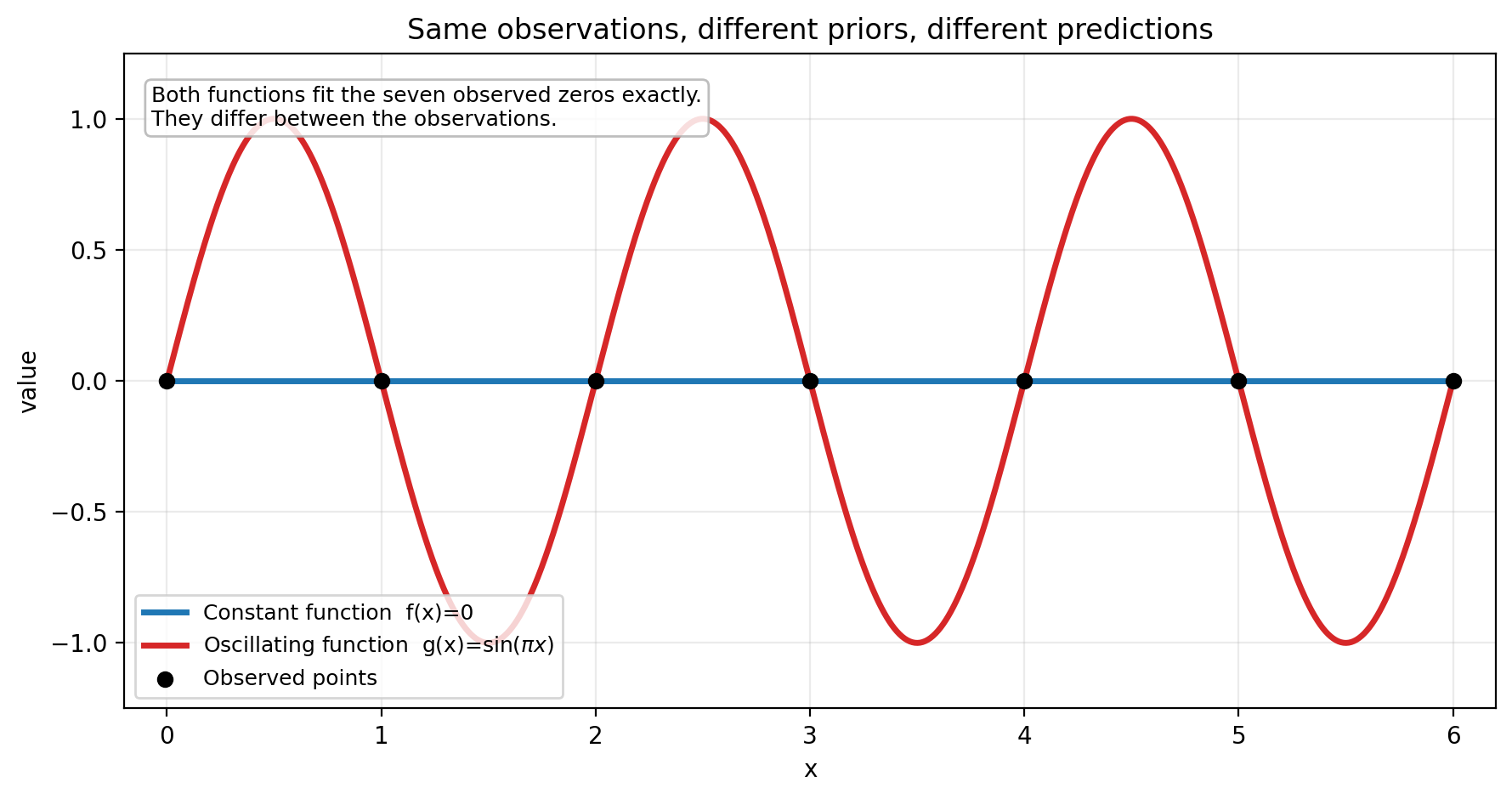
Same observations. Different priors. Different predictions.
A preference for periodic functions alone would not force the wave—the flat line is periodic too. We need an additional preference or restriction to choose between them.
The observations tell us what fits. The prior helps determine what comes next.
Now replace the seven zeros with a million human judgments. An AI might reproduce all of them yet reach a different conclusion in a new situation. The issue is not how many examples match. It is what constrains the possible rules consistent with those examples.
The Platonic Manifold Ideal
There is a serious optimistic answer to the problem of different priors. Perhaps sufficiently capable learners converge toward a shared representation of the world, even if they begin with different architectures and training objectives.
The inspiration is the Platonic Representation Hypothesis, proposed by Huh et al. They present some evidence that different AI models increasingly learn similar representations, and conjecture that capable learners approach a shared statistical model of reality. This is a serious possibility: the world itself supplies common constraints. Gravity, cause and effect, and the structure of language are not different for every learner. Their hypothesis concerns learned representations; it does not claim that AI systems necessarily converge on human moral judgments.
I call one stronger possible justification for alignment the Platonic Manifold Ideal: not merely that models discover similar descriptions of reality, but that this common structure—or sufficiently restrictive shared priors—also makes their moral extrapolations agree with high probability. Just to be clear, this is my name for an alignment-related extension of the hypothesis, not a claim made by its authors.
I take that possibility seriously. I think a compact underlying structure is likely. I am skeptical, however, that the structure is sufficiently unique, especially when we move from describing the world to deciding what ought to happen in it. I suspect the ideal is unlikely to hold strongly enough for reliable alignment. But I could be wrong.
The distinction is between two kinds of convergence:
Representational convergence: Do different learners increasingly discover the same underlying structure?
Normative convergence: Does that shared structure sufficiently constrain how they generalize human preferences and moral judgments?
The first does not establish the second. Two people can agree about the consequences of an action yet disagree about whether it is justified. An AI could know exactly what a decision will do without giving its consequences the same priority a human would.
The seven zeros above show why. Both curves fit every observed point. Only an inductive bias—a preference for certain explanations over others—tells us how to fill the gaps. Likewise, discovering the same facts about the world does not by itself dictate how to rank the outcomes of different actions. The Platonic Manifold Ideal succeeds only if the shared structure constrains these choices, not just the facts used to make them.
What Would Make the Ideal Work?
A manifold-based account can supply the missing ingredient only if it rules out competing extrapolations. It is not enough to say that humans and AI both have compact representations. We need restrictions on which representations and decision rules are admissible.
Perhaps the systems favor the same simple explanations. Perhaps they respect the same symmetries: changing an irrelevant person’s name should not change a moral judgment. Perhaps they learn causal constraints linking actions to harm rather than merely associating words with disapproval.
Each shared restriction eliminates some explanations that would otherwise fit the data. If the remaining explanations agree on the important cases, high-probability alignment becomes plausible. If they do not, millions of matching answers may tell us too little about the next unfamiliar situation.
This is the inductive-bias argument. With unrestricted hypotheses, the observed examples can be extended in arbitrarily many conflicting ways. In a deliberately artificial example where unseen yes-or-no labels are independent fair coin flips, observing the earlier labels does not help predict a new one: agreement is only 50% on average. Real human judgments are not random coins; that is precisely why we must identify the structure doing the work, rather than assume that observed agreement is sufficient.
So here is a concrete target for model-centered alignment research: identify which shared structural restrictions eliminate competing moral generalizations, and establish a bound on consequential disagreement outside the training examples. That would turn the Platonic Manifold Ideal from an appealing intuition into a testable route to alignment.
Evolution and Gradient Descent
Human moral cognition was shaped by evolution, physical vulnerability, culture, social dependence, and lived experience.
LLMs take another route: typically next-token prediction followed by preference optimization, reinforcement learning, and other forms of behavioral training.
These methods can change a model’s internal representations, sometimes substantially. Different learners might also discover common abstractions: they inhabit the same world, and AI training data contains an enormous amount of human thought. Their representations are not necessarily incompatible.
But compatibility does not follow from observed agreement either. Two learners can recognize the same boundary yet weigh it differently when an unfamiliar situation pits it against another goal.
No hidden malice is needed. No desire to deceive. Just a different extension of a learned rule.
The AI did not necessarily forget the rule. It may have generalized differently.
You Cannot Teach a Policy Without a Prior
There is an important objection to the Platonic picture: why should an AI independently converge toward human morality at all? Why not simply teach it the decision policy we want?
But this does not bypass the generalization problem. It is the generalization problem.
A decision policy is a function: given a situation, choose an action. If the policy can be arbitrary, knowing its answers on some situations cannot determine its answers everywhere else. We could specify every input-output pair, but even a discrete world has a combinatorial number of possible situations. Exhaustive instruction is not realistic for useful agents.
Learning from fewer examples becomes possible only because something constrains the alternatives: a prior favoring simple rules, useful features, causal assumptions, invariances, feedback, or an explicitly restricted policy class. Training can supply those constraints rather than merely assume them. They need not reproduce human cognition or come from a universal Platonic geometry.
But then the question becomes concrete: why do the constraints selected by training favor the human-compatible extensions of the policy, rather than other functions that fit the same examples? Saying “teach the policy” is not an answer until we explain how it generalizes.
Deployment Is a Stream of Perturbations
Every deployed agent encounters variations on what it learned: different wording, new people, unfamiliar combinations of familiar constraints. Some are small changes; others are genuine departures from its training distribution. Perturbations are not exceptional cases. They are ordinary deployment.
Return to the seven zeros. Two curves agree on the observed samples and diverge between them. Similarly, a model may correctly refuse to reveal a confidential document in familiar tests, then receive a slightly different request presenting disclosure as necessary for a legitimate task. Whether it still respects the restriction depends on the generalization it learned.
Not every small change should preserve a decision. A minor difference in authorization can legitimately reverse what is permitted. What matters is stability under morally irrelevant changes and sensitivity to morally significant ones. Ordinary numerical smoothness alone cannot tell us which is which.
Robust generalization is not an extra feature of alignment. It is what alignment demands as soon as a model is deployed.
The mathematical target, then, is not identical coordinates or identical manifolds. It is to identify decision-relevant invariants—and establish that the learned policy preserves them with sufficiently high probability on the consequential situations that matter. People disagree too, so a serious claim must also specify whose judgments count, the deployment distribution, and the acceptable frequency and severity of disagreement.
Two Approaches, Two Different Jobs
Model-centered alignment and external security address different problems. Alignment aims to shape what the model is likely to choose. Security mechanisms constrain what the system can actually do.
A model’s learned preference not to make an unauthorized payment is different from a payment service that refuses the transaction. Conversely, access controls cannot supply every subtle judgment a useful agent must make. The two approaches belong together.
In my earlier discussion of AI kill switches, I examined what independent containment would actually need to guarantee. The question here is different: what could justify confidence in internal alignment’s generalization?
We have become extraordinarily good at training machines to produce human-like answers. The Platonic Manifold Ideal offers one appealing reason that agreement might persist. Deliberately engineered inductive biases offer another. Either way, the missing step is to show which restrictions on generalization actually preserve the judgments we care about.
The manifold hypothesis suggests how intelligence can generalize. The Platonic Manifold Ideal suggests why different intelligences might generalize alike. Alignment must establish why they would generalize alike about what matters.
Matching the answers is not the same as establishing why the next answer should match.
*Author’s note: I use AI tools for editing and research assistance; the arguments and views here are my own.